Milwaukee’s Cesar Chavez statue is covered and expected to be removed amid national reassessments
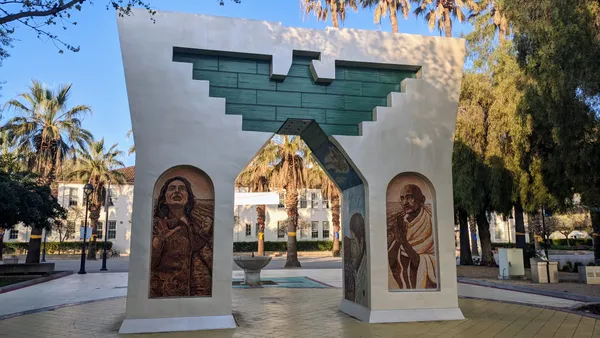
Statue on Cesar E. Chavez Drive becomes focus of local questions as other cities act
A life-size statue of labor leader César E. Chávez on Milwaukee’s near South Side has been covered and is expected to be taken down, reflecting a fast-moving national reassessment of public tributes linked to his legacy. The statue stands near the entrance to the Cesar Chavez Drive commercial district in the Clarke Square area, where it has served for a decade as a landmark tied to neighborhood identity and placemaking.
The Milwaukee statue was unveiled on March 31, 2016, during a public ceremony held in the pedestrian plaza outside Supermercado El Rey at 916 S. Cesar E. Chavez Dr. The installation was financed through community fundraising and partnerships connected to local corridor revitalization efforts; organizers at the time said more than $50,000 was raised to create and install the work.
Why the statue matters to Milwaukee’s near South Side
The monument has been part of a broader strategy to reinforce Cesar E. Chavez Drive as a cultural and commercial destination. City materials describing the Chavez Drive Business Improvement District note the statue as a feature that welcomes visitors to the corridor. In later years, the surrounding public space—often referred to as “La Placita”—was incorporated into additional public-realm projects and neighborhood programming.
For many residents and business owners, the statue has functioned as more than a standalone artwork, anchoring a gathering space and signaling the corridor’s Latino heritage and civic presence. Its removal would therefore carry implications beyond the immediate question of one monument, touching on how the city and community partners curate public memory in shared spaces.
National context: removals and renamings accelerating in March 2026
Milwaukee’s situation is unfolding alongside actions taken elsewhere in the United States, where institutions have moved to cover or remove monuments and to reconsider place names connected to Chávez. In recent days, officials at California State University, Fresno, first covered a campus statue and then enclosed it, announcing it would be removed. Denver also removed a bust of Chávez from a city park and initiated steps toward renaming the site.
- In multiple jurisdictions, officials have moved quickly to conceal monuments prior to removal.
- Some governments and institutions have also begun reviewing commemorative names, including parks and civic holidays.
What comes next locally
In Milwaukee, the expected takedown raises practical and policy questions that typically accompany changes to public art: who has decision-making authority over the site, how the work will be handled or stored, and what—if anything—will replace it. It also highlights the distinct governance landscape for prominent corridor features that sit at the intersection of private property, business improvement district activity, and public-facing civic space.
Across U.S. cities, the immediate step has often been to cover monuments before determining the longer-term outcome.
As Milwaukee considers the statue’s next chapter, the broader issue remains how public spaces should adapt when the meanings attached to long-standing tributes shift rapidly—and how changes can be managed with clarity about process, stewardship, and community impact.